

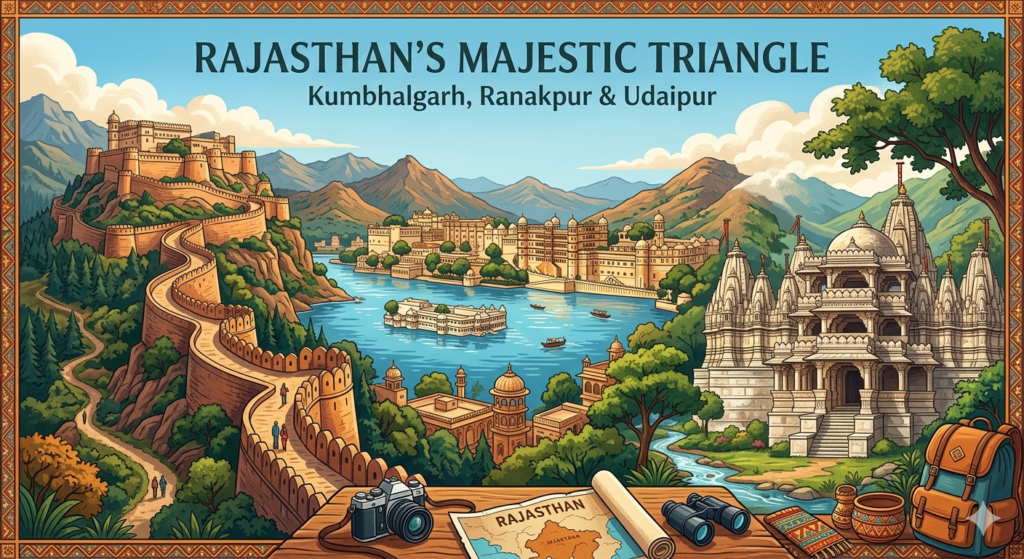
We planned a trip from Udaipur to Kumbhalgarh and Ranakpur, which are around 100 km away. Since Kumbhalgarh is not well connected by public transport, we booked a taxi in advance and hired it for two days, starting our journey at 8:30 AM.
After breakfast at the hotel, we headed towards Kumbhalgarh. Our first stop was Eklingji Temple, a place quite popular among locals. On arrival, we saw a long queue of devotees. There were no shops outside, but inside the main gate, vendors were selling flower garlands along the queue, making it convenient for visitors to buy offerings.
The line moved quickly, and we soon reached the sanctum to offer our prayers. Cameras and mobile phones were not permitted inside, so we couldn’t take any pictures.
From Eklingji, we continued to Nathdwara. There is an entry tax for vehicles entering the town, and the roads are narrow with heavy traffic. The temple here has unusual opening hours, as it closes multiple times during the day.
A friend of mine knew a pandit who could help us get quicker access for darshan. She contacted him on the way and arranged a meeting point. After parking, we walked to the temple, met him, and paid a fee for faster entry. Inside, it was quite crowded, and again, phones and cameras were not allowed. After a brief darshan of the idol, we were asked to move along quickly. Some priests near the idol asked for donations even though we had already contributed, so it’s better to politely ignore such requests. Afterward, we walked back through the narrow lanes, picking up souvenirs, prasad, and snacks on the way.
Our next stop was Haldighati, the historic site of the battle between Maharana Pratap and the Mughal forces led by Man Singh I under Emperor Akbar. We visited the valley where the battle took place and also saw the memorial dedicated to Chetak, Maharana Pratap’s horse.
We then headed to the Maharana Pratap Memorial, a large complex surrounded by high walls. After purchasing entry and camera tickets, we explored the site. There were statues depicting scenes from the battle in a garden, along with halls where visitors are guided through exhibitions showcasing the life of Maharana Pratap. The displays included clay models, colorful statues, and sound effects that added to the storytelling. Though there was a queue, we waited patiently as it is the main attraction here.
At the back of the complex, there were stalls selling local products like gulkand, rose water, honey, and handicrafts. The canteen served a fixed vegetarian thali on a self-service basis, and the food was quite spicy.
After lunch, we continued to Kumbhalgarh, where I had pre-booked a hotel. After checking in and freshening up, we visited Kumbhalgarh Fort, the main attraction in the area apart from the wildlife sanctuary.
We purchased entry tickets and also inquired about the evening light and sound show, deciding to book tickets in advance. Entering through the massive main gate, we noticed the thick walls, approximately 15 meters wide, with stairs leading up to them, which we explored.
The fort is located on a hilltop and has a massive wall stretching 36 kilometers, making it the second-longest wall in the world after the Great Wall of China. Built in the 15th century by Maharana Kumbha, it is also known as the birthplace of Maharana Pratap.
We climbed to the top of the fort, passing several small structures and gates along the way. The path included stone slopes and stairs. The climb took about an hour, as we paused frequently to take photos. The view from the top was stunning and worth the effort. After spending some time there, we descended in time for the evening show.
We found seats for the light and sound show, which are available on a first-come, first-served basis. The show was impressive and definitely worth watching. After it ended, the entire fort and its walls were illuminated for about 20–30 minutes, creating a spectacular golden glow. It was mesmerizing, but since it was getting late, we eventually left. We chose to have dinner at another nearby hotel, which had a pleasant garden setting and decent food, before returning to our hotel.
The next morning, we woke up a bit late and enjoyed the scenic view from our room, overlooking hills and a valley. The hotel staff mentioned that leopards are occasionally spotted in the open areas nearby. We also learned that a marathon is organized once a year on the fort walls, usually in January or February.
After breakfast, we spent some time exploring the surroundings before checking out and heading to Ranakpur. The drive was smooth, with tree-lined roads and several winding turns.
The Jain temple at Ranakpur is located in a peaceful area outside the city. There were fewer tourists, and most visitors were Jain devotees engaged in पूजा. Some people were also staying in rooms within the temple complex.
As per the guidelines, photography is allowed inside the temple only between 12 noon and 5 PM. The temple, built of white marble, is beautiful, with intricate carvings on its walls and pillars, though not as elaborate as the Dilwara temples. Visitors are expected to maintain silence and avoid photographing idols. The premises were clean and well-maintained, although the toilet facilities were limited, which can be inconvenient after long travel.
There was a clean canteen serving simple vegetarian food.
From Ranakpur, we headed back to Udaipur to catch our train to Delhi. Since we had some time before departure, we explored the local markets, enjoyed some snacks, and packed a few items for the overnight journey.
FAQs
Where are Kumbhalgarh Fort and Ranakpur Temples located?
Kumbhalgarh Fort and Ranakpur Temples are located in the Aravalli Hills of Rajasthan, around 80–100 kilometers from Udaipur.
Can you visit Kumbhalgarh Fort and Ranakpur Temples in one day from Udaipur?
Yes, both places can be covered in a single day trip from Udaipur, although it may involve a long day of travel.
What is Kumbhalgarh Fort famous for?
Kumbhalgarh Fort is famous for its massive wall, which is the second longest continuous wall in the world after the Great Wall of China.
What are Ranakpur Temples known for?
Ranakpur Temples are renowned for their intricate marble architecture and beautifully carved pillars, especially the Jain temple dedicated to Lord Adinath.
How far is Kumbhalgarh Fort from Udaipur?
Kumbhalgarh Fort is approximately 85 kilometers from Udaipur and takes around 2.5 to 3 hours by road.
How far are Ranakpur Temples from Udaipur?
Ranakpur Temples are about 90 kilometers from Udaipur and can be reached in around 2.5 to 3 hours.
What is the best way to travel to Kumbhalgarh and Ranakpur from Udaipur?
Hiring a private taxi or driving yourself is the most convenient way to visit both locations in one trip.
What is the best time to visit Kumbhalgarh Fort and Ranakpur Temples?
The best time to visit is between October and March when the weather is pleasant for sightseeing.
Is there an entry fee for Kumbhalgarh Fort and Ranakpur Temples?
Kumbhalgarh Fort has an entry fee, while entry to Ranakpur Temples is generally free, though donations are encouraged.
How much time is needed to explore both places?
You’ll need around 5 to 6 hours to comfortably explore both Kumbhalgarh Fort and Ranakpur Temples.
Are guides available at these attractions?
Yes, local guides are available at both sites to help visitors understand their history and architecture.
Is it safe to travel from Udaipur to Kumbhalgarh and Ranakpur?
Yes, the route is generally safe, with good road connectivity and regular tourist movement.